
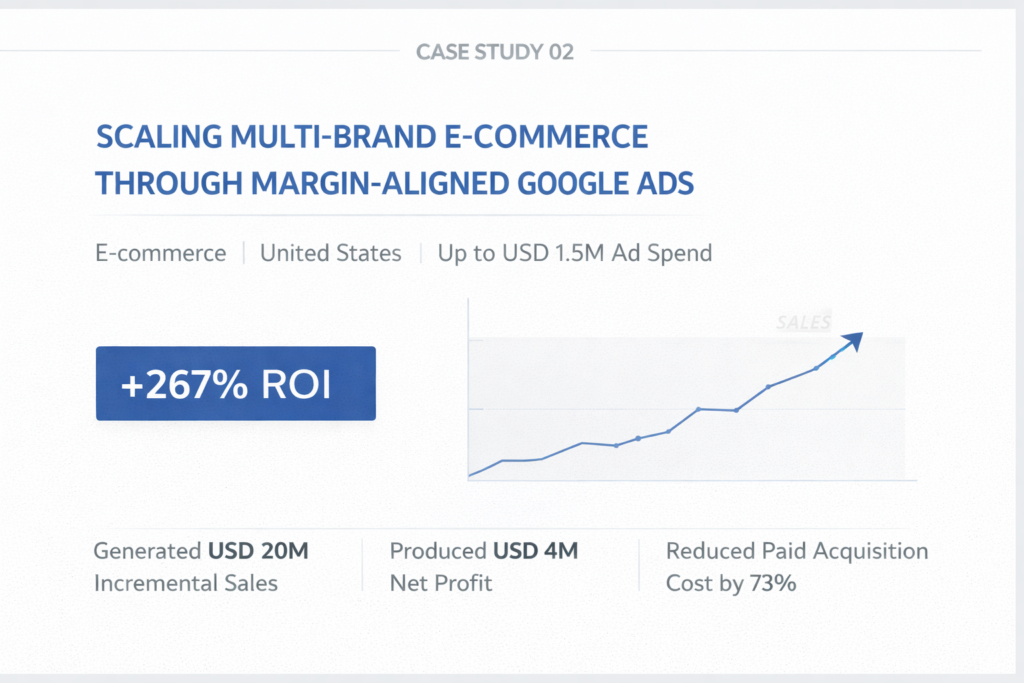
Industry
E-commerce
Geography
United States
Budget Scale
Up to USD 1.5M in managed ad spend
The Business Context
Several US-based e-commerce brands were already investing heavily in Google Ads across Search and Shopping. Revenue was coming in. On the surface, growth looked healthy.
But when Digital Profound looked deeper, the numbers told a different story.
Acquisition costs were climbing.
Some product categories were profitable. Others were barely breaking even.
Scaling meant increasing spend, not improving efficiency.
The problem was not traffic. It was margin control.
The real objective became clear. Build a paid acquisition system that could scale without eating into profit.
What We Found
After a full account review, a pattern emerged.
Campaigns were structured around revenue, not contribution margin.
High-spend products were not always high-profit products.
Shopping feeds were not built around buyer intent.
Keyword clustering did not reflect profitability by category.
Paid campaigns were operating in isolation from SEO and lifecycle marketing.
There were also small but costly UX issues that were reducing conversion efficiency.
This was not about changing bids.
It required rebuilding the foundation.
What We Changed
Rebuilding the Account Structure
Search and Shopping campaigns were reorganized around product clusters and margin tiers. Instead of grouping by convenience, we grouped by profitability.
This alone changed how budget flowed through the account.
Aligning Bids with Profit
Bid strategy was recalibrated to reflect contribution margin.
Low-margin products stopped consuming disproportionate spend.
High-margin products were given controlled scale.
Optimizing Product Feeds and Creative
Product titles and descriptions were refined for clarity and intent alignment.
Ad messaging was tightened to improve click-through rate without attracting low-quality traffic.
Connecting Paid with the Rest of the Funnel
SEO improvements, remarketing, and email marketing were aligned to support paid acquisition.
Cold traffic did not have to do all the work.
Fixing Conversion Friction
Navigation and checkout flow were refined.
Small changes in user journey translated into measurable conversion improvements.
Results
The transformation was measurable.
USD 20M in incremental sales generated
267 percent return on investment
USD 4M in net profit
73 percent reduction in paid acquisition cost
4 percent improvement in overall conversion rate
Up to USD 1.5M in advertising budgets managed efficiently
These were not short-term spikes. The gains were sustained through structural alignment.
The Bigger Shift
Paid acquisition moved from being a growth lever to being a profit system.
Instead of chasing volume, the campaigns were engineered around margin.
Instead of reacting to rising costs, the account operated with financial discipline.
Google Ads became a profitability engine, not just a traffic source.
That shift changed how scale was approached going forward.